
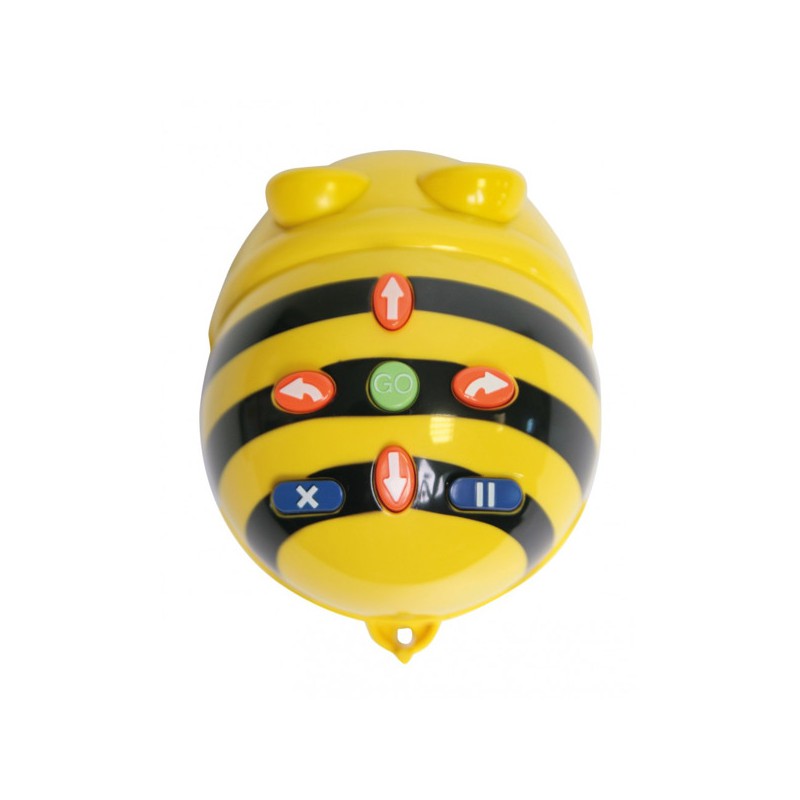
Structure:
The Bee-Bot Mission is a gamified learning module for Grade 8 students. Its design is based on the content gamification design approach and Meaningful Gamification Framework (Kapp, Blair, & Mesch, 2014; Nicholson, 2015) discussed earlier in gamification design approaches. The design elements applied in the module
Prior Knowledge: Learners should possess some basic knowledge of the Bee-Bot functionalities, and at least a basic familiarity with Scratch and its mechanism of snapping blocks together to specify program instructions.
Description
The Bee-Bot mission begins when Jack, a ten-year-old boy, needs the player/learner’s help to accomplish his own version of the Bee-Bot application using Scratch. The mission is composed of a series of six quests (lessons/ learning units) that will aid the learner in completing a final epic-quest (the Bee-Bot application project). The following is a list of the learning quests and the approximate time required to complete each. The total time required is approximately 15 hours:
- Quest # 1: Hardware Vs Software [1 Hour]
- Quest # 2: The Software Development Life Cycle (SDLC) [2 hours]
- Quest # 3
:The Analyst: Analysis & Specifying the Requirements [2 hours] - Quest # 4: The Designer: Using Algorithms [2 hours]
- Quest # 5: The Coder: Implementation [3 hours]
- Quest # 6: The Tester & Debugger: Evaluation and Debugging [1 hour]
- Tiny Epic-Quest [4 hours]
The Bee-Bot Mission Learning Module
Link for full screen and mobile view.
Rules of the Mission:
- At each quest, learners will assume the identity of a different career in the computing field (i.e.the analyst, designer, coder, tester and debugger) and gain a conceptual understanding of their role and tasks. For instance, the designer should develop algorithms to be used by the coder at a later stage and also connect it to the mission theme.
- Learners must complete required activities such as reflections in their journey book.
- To pass a quest and move to the next one, learners must complete a quiz, also known as a Boost Fight. Boost Fights are designed to help the learner assess their level of understanding of the quest. Moreover, they assist in accomplishing the final epic-quest.
- After completing a Boost Fight, learners will have the opportunity to provide feedback and will earn a badge to acknowledge their achievement.
- Once a learner finishes all the required quests, they will be grouped with a pair of other students to complete the tiny epic-quest.
- After completing the epic-quests, learners will receive feedback, a grade and earn the golden badge that indicates successful completion of the mission.
BC standards Grade 8:
Content from the Bee-Bot Mission includes three standards of the “Computational Thinking” module from the ADST British Columbia Curriculum Standards for Grade
- “Software programs as specific and sequential instructions with algorithms that can be reliably repeated by others.
- Debugging algorithms and programs by breaking problems down into a series of sub-problems.
- Programming languages, including visual programming in relation to text-based programming and programming modular components” (BC Ministry of Education, 2018).
Teaching/Learning Strategies:
Educators are required to:
- Introduce the expectations of the mission.
- Provide scaffolding about the concepts and skills students learn in the various quests of the Bee-Bot Mission.
- Pair each learner with two others to complete the epic-quest and provide instructional scaffolding as needed to support any difficulties learners may face completing their epic-quest.
- Evaluate learners’ epic-quests using the grading rubric below and provide learners constructive feedback to inform their own learning.
Assessment and Evaluation:
- Each learner is expected to individually complete the required Boost Fights to assess their own understanding of content and to prepare them for the final epic-quest.
- The learner can retake the Boost Fight as many times as needed.
- As soon as the learner completes a Boost Fight, feedback is provided to guide and support the student’s learning.
- The epic-quest is a small-scale project that allows the learners to apply the knowledge acquired throughout the quests. It is graded out of 100; the grading details are provided in the following grading rubric:
Technology Requirements:
- Learners should have access to computer devices and an internet connection to be able to complete the learning requirements.