
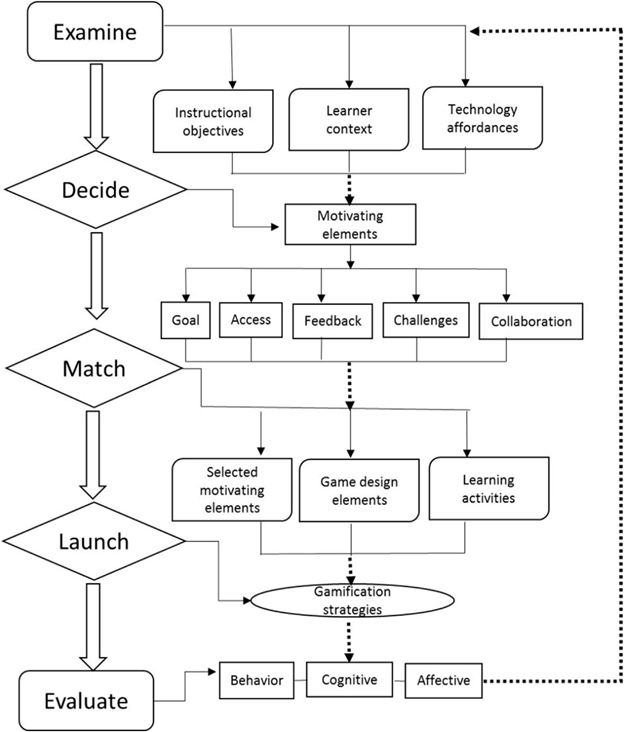
The diagram below from (Huang & Hew, 2018) shows a five-stage gamification design procedure.
Recommendation for Educators and Instructional Designers

Gamification is just like any other instructional technique you employ. Your early iterations will be far from perfect; however, based on reflections and ongoing feedback from learners, the subsequent iterations are likely to improve. The following recommendations are adapted from Hung (2017).
- Selecting an appropriate lesson to gamify is critical since many lesson objectives may not actually be facilitated by gamification. If your content is about complicated theories and is too complex to understand, it may not be appropriate to gamify.
- You don’t have to start big! Incorporate scalability in your design. Your design and lesson planning will become smoother and will continue to go through improvements based on feedback and reflections from your learners.
- Focus on the learner – Think of how gamification is intended to improve the learner’s experience. It can be used to give learners a better sense of their progress through better, more timely and useful feedback.
- Define your Learning Objectives – Successful gamification experiences are based on the ability to combine game mechanics and learning objectives effectively.
- Lesson-level versus unit-level? Gamification experiences can be targeted at various levels, ranging from the instructional-level to lesson, course/unit, and possibly even to the program level; a program being composed of some courses. At the instructional level, a gamification experience is created for one or more instructional events within a lesson that is perhaps 5 to 10 minutes long. At the lesson level, a gamification experience may be one where learners could reasonably complete it in a single lesson or single class period, for example, 40 to 60 minutes. At the course/unit-level, a gamification experience may encompass a series of lessons aimed at achieving a more complex learning objective. At this level, the lesson plan may contain activities, meaningful questions, work assignments, and assessments spread across one or more lessons. The Bee-Bot Mission is an example of a unit-level gamification experience.
- Design a game plan using a gamification design approach (i.e. structural, content, etc.).
- Pick one or two game mechanics that you are comfortable with. For example, in this learning platform, badges and points are used to enhance the audience engagement. Moreover, consider how your mechanics will work and advance your content gamification narrative.
- Don’t put technology at the center: Though technology is essential in the gamification process, it should not be the starting point.
- Revise and reiterate: Gamified designs should go through continuous improvement. as new research and frameworks emerge.
- Remember gamification isn’t about transposing reward systems onto existing teaching materials and assessments. There are other mechanisms that need to be involved including: setting clear rules, using progressive difficulty, embedding interaction and social elements, having a degree of uncertainty and challenge, creating a fictional setting if you are utilizing content gamification, and before all that, providing immediate and constructive feedback, one of the most potent mechanisms for any successful gamification.
- Play and have fun: YES! Gamification should be about having fun, not just for the learners but for the educators too. If neither party is having fun, then gamification serves no purpose.
Feel free to share more recommendations in the comments section.
Very useful background, especially the explanation of game mechanics.